
Sedation Service:
Implant Treatment & Tooth Extraction
Gentle, Reassuring Dental Implant Surgery with Sedation Options
Many people feel very apprehensive about dental surgery. It can be a daunting prospect, even if you haven’t had a particularly bad experience in the past.
The team at The Implant Centre will take the utmost care to ensure that your experience at the centre is as comfortable as possible. Our surgeons and dentists will talk to you throughout your treatment, explaining as much or as little as you wish. Many of our patients have commented that they find this to be extremely calming and reassuring.
It is often the case that, with careful treatment planning and discussion, implant dentistry can be much less traumatic than root-canal treatment or having crowns and bridges made.
Most of our patients are happy to be treated under a normal dental local anaesthetic. However, for more nervous patients or for larger cases, we are happy to offer sedation which will leave you totally unaware of the treatment being carried out making your surgical experience far more relaxed.
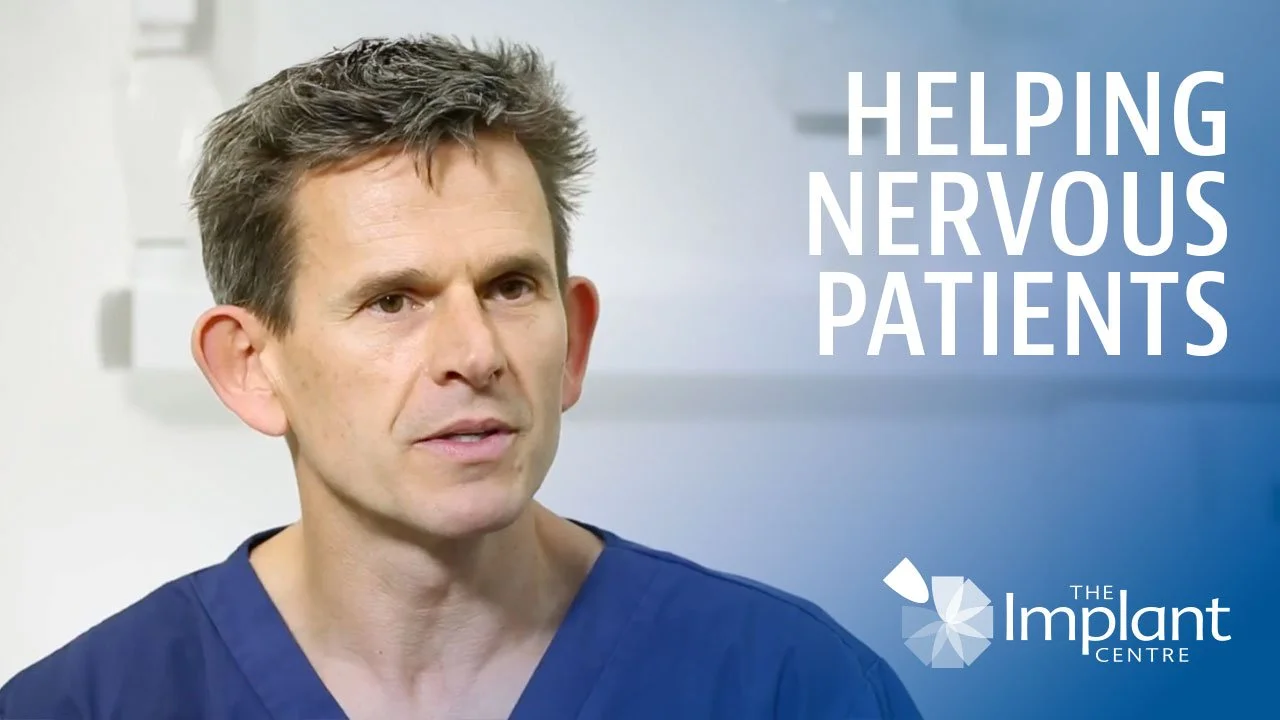
‘The team at The Implant Centre will take the utmost care to ensure that your experience is as comfortable as possible.’

Dr Rex Yetton
Our anaesthetist who provides sedation at The Implant Centre.
Rex has a gentle caring manner which is very reassuring for patients who are nervous of dental treatments and who can benefit from intravenous sedation
See some of our Expert Advice videos




Frequently Asked Questions
-
We offer intravenous sedation, which is provided by our dedicated anaesthetists, Dr. Rex Yetton and Dr. Mel Keel. It is important to understand that this is not a general anaesthetic. Instead, it is designed to make you feel deeply comfortable and relaxed throughout your procedure. Most patients find that they remain conscious but feel very calm, and they rarely remember much about the treatment afterward, making it an excellent option for those who feel anxious.
-
Yes. Dental sedation is a safe and highly effective way to manage anxiety, provided it is administered correctly. At our practice, sedation is always delivered by our experienced, dedicated anaesthetists, Dr. Rex Yetton and Dr. Mel Keel. Because your care is in the hands of specialist anaesthetists, your vital signs and comfort levels are monitored continuously throughout the entire procedure. This rigorous approach ensures that your safety is maintained to the highest clinical standard at all times, allowing you to undergo your treatment in a deeply relaxed and secure state.
-
Sedation is not a general anaesthetic, meaning you are not put to sleep in the same way. Instead, most patients describe the experience as feeling deeply comfortable, heavy, and very relaxed. While you remain conscious and able to respond, the procedure tends to feel as though it happens very quickly. Because of the sedative effect, most patients rarely remember much about the treatment afterwards, which helps to remove the stress and anxiety often associated with dental visits.
-
Patients under sedation rarely remember much about the procedure afterwards. This is widely considered one of the main advantages for nervous patients, as it allows you to undergo your treatment without the stress or anticipation that can often accompany a dental visit. Most people find that the time passes very quickly, leaving them with no unpleasant memories of the procedure itself.
-
Yes. Sedation is an excellent and popular option specifically offered for nervous patients and for larger, more complex cases. Our dedicated anaesthetists, Dr. Rex Yetton and Dr. Mel Keel, are widely recognised for their gentle, caring manner, which is incredibly reassuring for those who are nervous about dental treatments. They work closely with you to ensure you feel supported and comfortable from the moment you arrive until the conclusion of your procedure. If you feel that your nerves are a barrier to receiving the care you need, please speak with us, and we can discuss whether sedation is the right choice to help you feel at ease.
-
After the procedure, the sedative effects do not disappear instantly. You will need to remain at the centre for a short period while you are monitored to ensure you are recovering safely. While you will feel much more like yourself after resting, the effects of the sedative medication can linger for the remainder of the day. Because of this, you will need to arrange for a friend or family member to collect you and accompany you home, as you must not drive, operate machinery, or make any major decisions for 24 hours following your treatment. We will provide you and your chaperone with detailed post-operative instructions to ensure you are comfortable and safe as the effects wear off completely.
-
As with any medical procedure involving medication, there are risks associated with sedation. However, these are significantly minimised when the sedation is administered by a qualified, dedicated anaesthetist in a controlled clinical environment. At our practice, your safety is our highest priority. By having specialists like Dr. Rex Yetton or Dr. Mel Keel present, your vital signs — such as your heart rate, blood pressure, and oxygen levels — are monitored continuously throughout the entire procedure. Before we proceed, we will conduct a thorough medical assessment to ensure that sedation is a safe and appropriate option for you. We will also discuss the potential side effects — such as temporary grogginess or light-headedness — and explain the necessary precautions to take after your treatment. Our goal is to ensure you feel secure and fully informed throughout every stage of your care.
-
Preparing for your sedation procedure is straightforward, and we will provide you with a clear, written guide to follow. There are a few key steps you will need to take before your appointment:
Fasting: You will likely be asked to refrain from eating or drinking for a specific period before your procedure. We will provide precise timing based on your appointment slot.
Arrange transport: You must not drive or operate machinery for 24 hours following sedation. Please arrange for a friend or family member to collect you from the centre and stay with you for the remainder of the day.
Medications: Please provide a full list of any medications you are currently taking during your consultation. We will advise you if any need to be adjusted before your visit.
Clothing: Wear loose, comfortable clothing that allows us to easily monitor your blood pressure and heart rate.
Rest: Try to get a good night’s sleep before your appointment. If you are feeling particularly nervous, please let us know in advance so we can offer extra support.
We will go over these instructions in detail during your pre-treatment consultation to ensure you feel fully prepared and confident about what to expect.
-
Yes. While sedation is frequently used for more complex, larger cases, it is entirely your choice. If you feel that your dental anxiety is significant enough that you would be much more comfortable with sedation — even for a minor procedure — we are more than happy to discuss this with you. Our priority is to ensure you feel calm, secure, and in control of your care. We can review your specific concerns during your consultation to determine if sedation is the most appropriate and effective way to help you manage your treatment.
-
In-house sedation by an anaesthetist costs £450 per hour, which is an additional cost on top of the treatment itself.
-
Yes, absolutely. We frequently perform multiple extractions during a single sedation appointment. This approach is often preferred by our patients, as it allows us to complete the necessary work efficiently in one session while you remain in a deeply relaxed, comfortable state. Our dedicated anaesthetists, Dr. Rex Yetton and Dr. Mel Keel, will ensure you are safely monitored throughout the entire procedure, no matter how many teeth are being removed.
-
Yes. For larger cases, sedation leaves patients totally unaware of the treatment being carried out. With careful treatment planning and discussion, implant dentistry can be much less traumatic than root-canal treatment or having crowns and bridges made.
-
No, you cannot go home alone. For your safety, you must be collected from the centre by a responsible adult who will accompany you home and remain with you for the remainder of the day. Because the sedative effects can persist, your coordination and judgement will be affected for 24 hours. You must not drive, operate machinery, or make any major decisions during this time. We will ensure you and your chaperone are fully briefed on your post-operative care before you leave.
-
Yes. If medical or personal reasons make sedation unsuitable for you, we have several alternatives to ensure you remain comfortable and in control:
Local anaesthetic with enhanced support: We can use advanced numbing techniques to ensure you feel no pain, combined with extra time and care to help you feel settled.
Topical anaesthetic gel: We apply a special gel to the area before any injections, so you barely feel a thing.
Dedicated communication and pacing: We prioritise explaining each step before it happens, giving you the power to pause or stop at any time.
A supportive environment: Our team is trained to assist those with high anxiety. We can use relaxation techniques, music, or simply take the procedure at a pace that works for you.
We will conduct a thorough medical assessment before any treatment to explore these options and determine the best approach for your specific needs.